
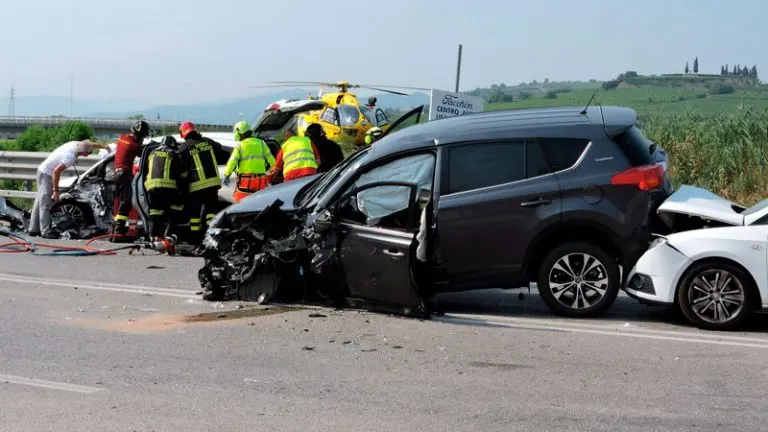
The human factor is known to be the main cause of most road accidents. Could it have anything to do with our poor perception of the risk we take when we get into a vehicle?

We have previously covered issues related to emotions at the wheel, the psychological consequences of traffic jams and strategies to improve attention on the road. But what about the risks of driving? Psychology applied to driving has a lot to say about this. Let us start from the thinking of Luis Montoro (Professor of Road Safety, University of Valencia), when he points out that “driving involves a large number of complex activities that carry a significant degree of objective risk”.
It sounds strong and yet, every day we start our working day aboard a roadside assistance tow truck, or a van, or a passenger vehicle (taxis, VTC or chauffeur-driven hire vehicles), doing our job as best we can and inevitably taking risks.
That is why the word “assessment” is so crucial when we talk about risks. Assessing the risk of a given manoeuvre or situation as rationally as possible can spare us tricky moments. Even catastrophic ones.
What are the types of risk?

Experts from the Directorate-General for Traffic (DGT) use the following classification:
- Objective risk, or the risk that actually exists in a given traffic situation.
- Subjective risk, or the risk that the driver perceives to exist at a given moment.
- Accepted risk, or the risk that each person considers they are willing to take, which will vary depending on the individual’s personality, the road conditions and the vehicle.
An increase in the perception of -subjective- risk can occur if we witness a road accident, seeing its lethal, tragic consequences face to face. Likewise through direct experience, when we learn of a case close to us. The key lies in matching subjective risk to the existing objective risk, which translates into prudent behaviour at the wheel.
Youthful inexperience, for example, would be a risk factor in itself; low risk perception is directly related to little experience.
Theories on risk
Risk compensation theory
Risk compensation theory, or risk homeostasis theory, put forward by Gerald Wilde in 1988, states that drivers make choices based on their perception of risk and the level of risk they are willing to accept. A vehicle in good condition, as well as a good road, will make our driving riskier. However, a correct assessment of risks can only come from awareness of accident rates and their consequences. Wilde points out that drivers must be encouraged to accept lower levels of risk.
Zero-risk theory
The zero-risk theory of Näätänen and Summala (1976) states that individuals are not willing to accept any risk at the wheel. Learning has given them a sense of security, a false one we might say, which prevents them from perceiving danger. It would not be a matter of attraction to risk or to what is forbidden, as happens with irrational drivers. Arriving somewhere on time would be an excitatory element, the experts point out. According to this theory, eliminating accidents would require, in addition to appropriate driving behaviour -combating the culture of speed-, greater predictability of events, as well as an absence of variability in traffic.
Threat-avoidance theory
Ray Fuller’s threat-avoidance theory argues that drivers must associate dangers with meaningful stimuli (signage) in order to anticipate and perceive the level of risk, acting accordingly. According to this theory, we would constantly be avoiding dangers, real or potential. The greater the anticipatory response, the lower the danger, and vice versa.
Van der Molen and Botticher’s hierarchical model
Finally, Van der Molen and Botticher’s hierarchical model assumes that we drivers choose the alternative with the greatest utility, subjectively speaking. Our prior learning, our motivation while at the wheel and our expectations all play a part here. It is a model that favours prudent actions over options involving greater risk.