
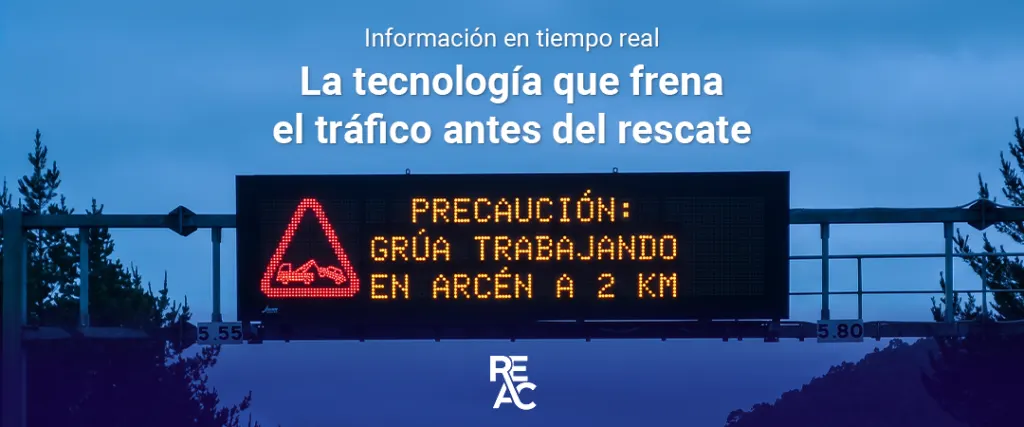
The protection of a rescue manoeuvre on a high-speed road does not begin when the tow truck switches on its beacons on the hard shoulder, but kilometres earlier. In the era of connected mobility, seamless interaction between traffic management centres, rescue fleets and Variable Message Signs has become established as the first line of defence for safeguarding the lives of roadside assistance operators and road users themselves.
Anticipation as a decisive factor in traffic engineering
At dual carriageway or motorway speeds (where vehicles travel at 120 km/h or more), a driver covers more than 33 metres per second. When faced with an unexpected obstacle or an emergency vehicle stopped on the carriageway, human reaction time combined with braking distance requires a manoeuvring margin of more than one hundred metres in optimal conditions.
In this scenario, the alerts displayed on Variable Message Signs (VMS) are no longer mere informative warnings but become active traffic engineering tools. Their main objective is to alter traffic flow progressively, drastically reducing the likelihood of rear-end collisions and secondary rear-end collisions, which represent one of the greatest risks in hard-shoulder accidents.
Direct benefits of Variable Message Signs for roadside assistance
1. Gradual, staggered speed reduction
Alerting the traffic flow through Variable Message Signs with sufficient distance allows drivers to ease off the accelerator in advance. This prevents the dreaded "concertina effect" and emergency braking, ensuring that vehicles approaching the intervention zone do so at a controlled and safe speed.
2. Channelling traffic and clearing the adjacent lane
One of the greatest dangers for the roadside assistance technician is the proximity of traffic in the lane next to the hard shoulder. By projecting lane-change pictograms on Variable Message Signs, drivers are encouraged to move over to the left-hand lane in good time. This manoeuvre opens up a vital safety corridor around the tow truck and the broken-down vehicle.
3. Real-time data integration and geolocation
The real qualitative leap lies in the digitalisation of fleets. Integrating the fleet's GPS positioning systems with the platforms of the Traffic Management Centres (such as the DGT 3.0 platform) allows the alert on Variable Message Signs to be activated almost automatically as soon as the tow truck arrives at the incident site or begins the rescue manoeuvre.
Operating protocols and synergy on the road
For the infrastructure's light-based technology to be effective, it must be backed by a rigorous operating protocol at the assistance site. The coordinated use of Variable Message Signs is complemented on the ground by:
- Preventive technical marking: Deployment of high-visibility cones and connected V-16 lights before starting to approach the affected vehicle.
- Class 3 High-Visibility Equipment: Ensures that the operator can be recognised from a great distance, even in conditions of reduced visibility or at night.
- Synchronisation with the control centre: Constant communication between the operator and the operating base to verify that the alerts on the public road remain active for as long as the loading or repair lasts.
Towards a mobility model with zero accidents on duty
The combination of smart infrastructure, networked technology in rescue vehicles and driver responsibility is the only path towards eradicating people being struck on the road. Signalling through Variable Message Signs shows that technology applied to infrastructure saves lives in the roadside assistance service.
At REAC we maintain a firm commitment to the continuous updating of our fleets and the adoption of the highest safety standards. You can find out more about our working systems by reading our specialist article on safety and marking protocols in roadside rescue.
Committed to innovation and road safety
On the REAC blog we regularly analyse the latest technological developments, traffic regulations and engineering solutions applied to roadside assistance. We invite you to follow our publications to keep up to date with progress in the sector.