
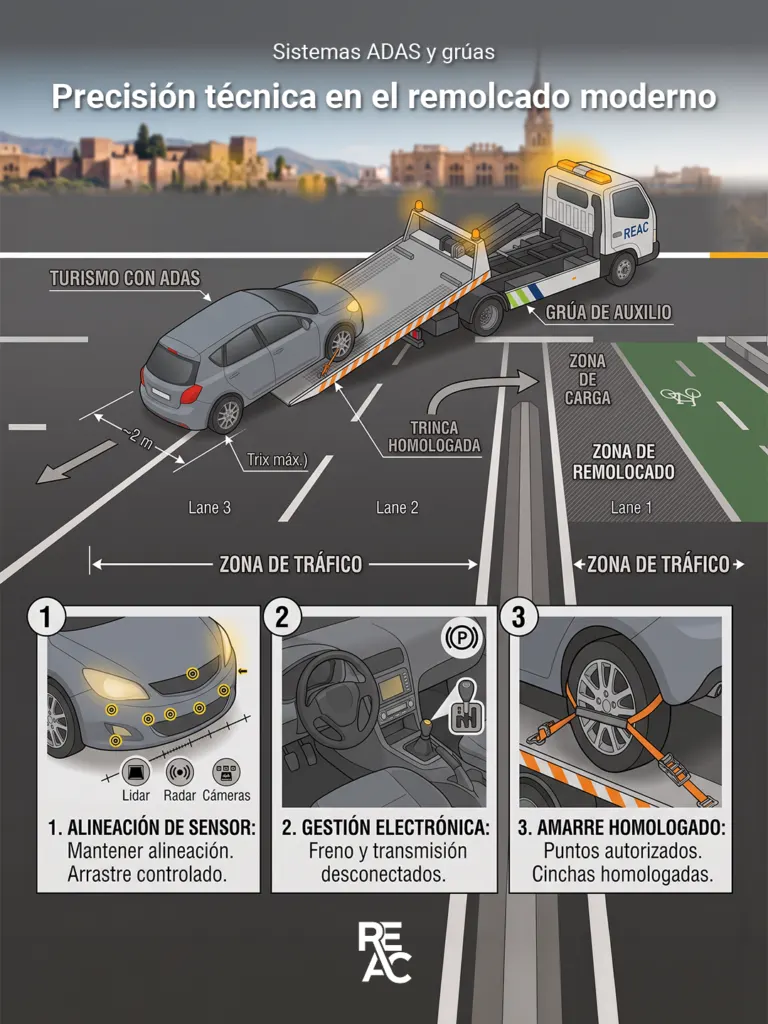
The gradual renewal of the vehicle fleet has brought vehicles equipped with sophisticated Advanced Driver Assistance Systems (ADAS) onto our roads. However, when a car fitted with this technology suffers a breakdown or accident, the rescue service can no longer be carried out according to traditional parameters. Modern towing demands rigour, continuous training and absolute technical precision.
The technological challenge of roadside assistance
Millimetre-wave radars in the lower bumper panels, cameras behind the windscreen for lane keeping and photoelectric sensors for autonomous braking are now part of the standard equipment of thousands of cars. Forced dragging or an inappropriate securing manoeuvre can knock these technical components out of calibration, causing critical reading errors once the vehicle is back on the road.
For this reason, the SMEs that make up the Red de Empresas de Auxilio en Carretera (REAC) apply standardised protocols to guarantee the technological integrity of the vehicle.
The 3 technical pillars of safe towing for vehicles with ADAS
1. Preserving and aligning sensors
Radars located in bumpers and bumper covers have mounting tolerances of less than one millimetre. Excessive force at the pulling angles while loading the vehicle onto the platform can cause deviations that are imperceptible to the naked eye but enough to disable the emergency braking system. The use of an extended ramp and reduced loading angles is mandatory in these cases.
2. Managing traction and integrated electronics
Many current vehicles are fitted with an electric parking brake (EPB) and automatic transmissions with no direct mechanical connection. Attempting to move the car without the appropriate electronic release procedure can cause irreparable damage to the gearbox or traction motors. The operator's technical training makes it possible to identify and apply the release sequence established by each manufacturer.
3. Approved anchoring and tie-down on the platform
The vehicle must be secured on the assistance platform using only the authorised tie-down points, axles and lashings. Applying tension to suspension components not intended for this purpose by the manufacturer can alter the steering geometry and misalign the guidance cameras.
Commitment to continuous technical training
At REAC we understand that travel assistance is an industrial specialism that evolves at the same pace as the automotive industry. The ongoing training of technicians and the modernisation of rescue equipment are the only guarantee of offering a safe, efficient service adapted to the demands of 21st-century mobility.
Are you part of the roadside assistance or fleet management sector?
Discover more about our operating standards and technical collaboration networks by visiting our professionals section.