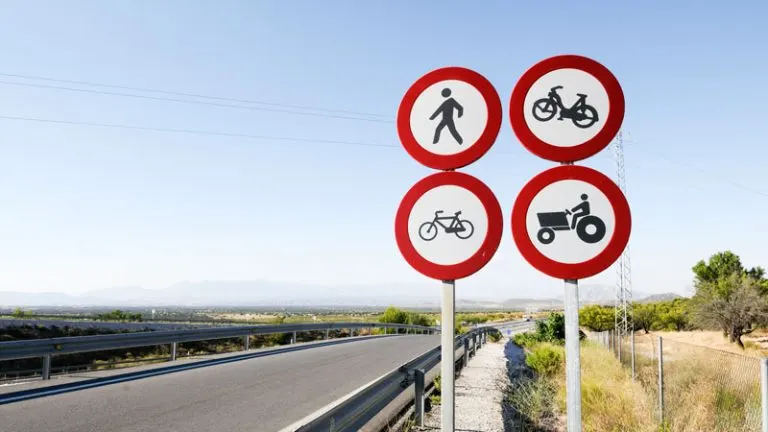
They warn of danger, regulate, give directions or mark roadworks. Road signs are there to help us drive properly, although some are not exactly common. Do you know them?
Last October we talked about the new sign aimed at vulnerable road users that the Directorate-General for Traffic (DGT) had created to warn of the danger of “blind spots”. We are still a long way from the utopian -although real- cities without traffic signs, but one thing is clear: we never manage to learn the meaning of every traffic sign… Here is a short list of some of the most unusual ones:
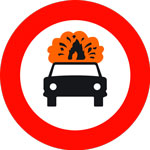
- R-109 is a prohibition sign, as shown by the fact that it is framed by a red circle. In this case, what it prohibits is entry to vehicles carrying explosive or flammable goods, hence the very strange little orange cloud drawn above the car.
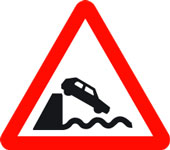
- P-27 is a warning sign, given its triangular shape, and what it indicates is that, if we continue along that road, we may plunge into a stream, river or the sea.
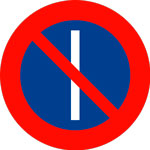
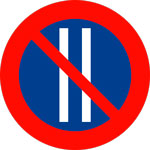
- R-308a and R-308b are no-parking signs, and the key to interpreting them lies in the vertical white line. Why? Because one refers to odd-numbered days (R308a) and the other to even-numbered days (R308b).
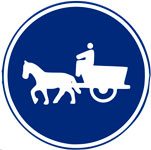
- R-408 is a vertical traffic sign indicating that we are on a route for animal-drawn vehicles.
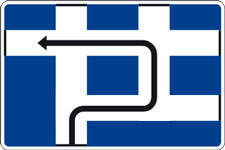
- S-250 looks like a strange circuit, and it does indeed indicate a specific route that drivers must follow. It is an urban sign.
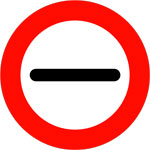
- R-200 is a sign that prohibits passing without stopping; in other words, stopping is compulsory because of the proximity of a customs or police post, toll booth or similar.
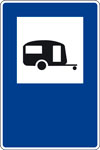
- S-113 belongs to the category of information signs, and in this case it indicates that we are on a site for caravans, or vehicles towing a trailer, like a caravan. Another similar sign is S-116, which indicates campsites and caravan sites.