
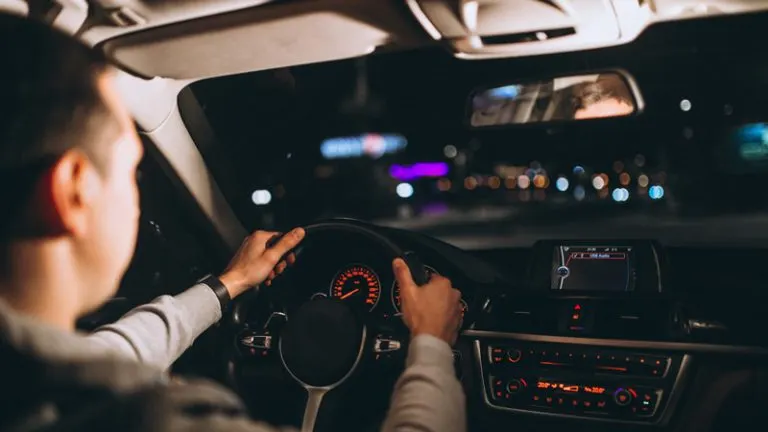
It is true that night-time is usually considered particularly dangerous for various reasons. So if we have to drive, we will need to pay attention to what we are about to set out below.

The reality for roadside assistance tow-truck operators is that the service is offered 24 hours a day, so working hours are unpredictable; a rescue can take place at any time (morning, afternoon, evening, early hours…). Night driving, which we mentioned when discussing car lights, has its dangers (the main one being a 20% reduction in vision).
The good news, in principle, is that traffic drops dramatically: 60% fewer vehicles is an invitation to drive, especially for those who like the night. The flip side of this figure is the number of serious -and fatal- accidents that occur in the small hours: 42% of them.
Natural daylight illuminates more than dipped beam or main beam headlights, which affects the perception of distances, people, objects… and vehicles themselves. In fact, one of the maxims at night is that seeing is as important as being seen by other drivers. This requires signage and lighting to be in optimum condition.
Risks of driving at night
What are the worst hours to drive? Auto 10 quotes the Road Safety Institute of the University of Valencia as indicating that between three and six in the morning is the time slot in which it would not be advisable to drive. Night driving requires adapting our speed to the speed limits, but not only that: also to our field of vision. Our vehicle should be able to stop within the limits of the illuminated area, since any obstacle that appears could give us a nasty shock.
So if we have to drive for professional or personal reasons, we will need to consider these circumstances:

- We may be dazzled because an oncoming vehicle has its main beam on (direct), although this will also happen if we see the main beam of the vehicle behind us in the mirror (indirect).
- Along the same lines, another danger lies in going from a well-lit road to a dark one; our eyes will adapt to the darkness, but not so easily, so our perception will be reduced.
- On the other hand, if we are driving in town, night-time lighting can be very intense, reducing the visibility of certain signs or road users such as cyclists, pedestrians, motorcyclists… in other words, vulnerable road users.
- Highway hypnosis occurs more often at night, especially when it is raining.