
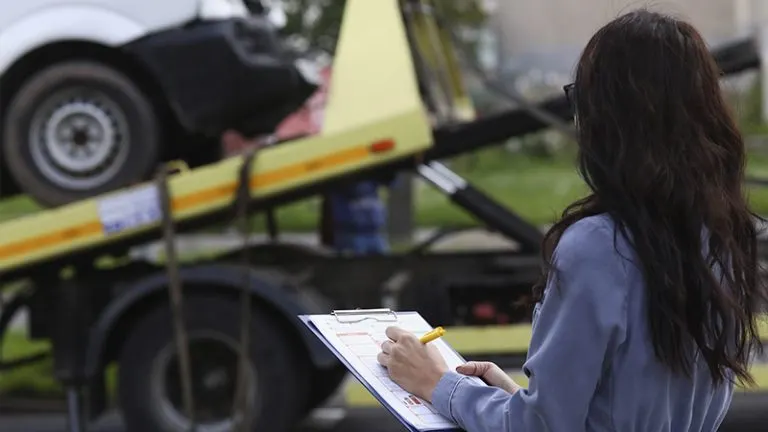
Today we will talk about the terminology that accompanies those of us who work in roadside assistance, from A to Z.
Being a roadside assistance operator, providing a tow-truck service, involves enormous responsibility. At REAC we know this. We talked at the time about the requirements for a roadside assistance tow-truck driver (in order to find out about the necessary licences).
But also about the Roadside Assistance Protocol of the Directorate-General for Traffic (DGT), which dates from 2015. Today we will focus on the glossary of terms.

- Hard shoulder, the paved longitudinal strip adjacent to the carriageway, not intended for use by motor vehicles (except in exceptional circumstances).
- Motorway, a road specially designed for the exclusive use of motor vehicles, with separate carriageways for each direction of traffic and no access to adjoining properties. It is not crossed by any other path, road, railway or tram line, or path and right of way.
- Dual carriageway, a road which, without meeting all the requirements of motorways, has separate carriageways for each direction of traffic and limited access to adjoining properties.
- Breakdown, damage not caused by an accident that prevents a vehicle from working.
- Verge, a longitudinal strip, surfaced or not, between the outer edge of the hard shoulder and the ditch or embankment.
- Carriageway, the part of the road intended for vehicle traffic, made up of a certain number of lanes.
- Conventional roads, those that do not have the characteristics of motorways, dual carriageways and expressways.
- Lane, a longitudinal strip into which the carriageway may be divided, whether or not marked by longitudinal road markings, and wide enough for a single line of motor vehicles other than motorcycles.
- Safe side, the side of the vehicle exposed to the lowest volume of traffic.
- Central reservation, a longitudinal strip located between two separate roadways, not intended for traffic.
- Roadway, the area of the road intended for use by vehicles (made up of the carriageway, the hard shoulders and the surfaced verges).
- Roadside assistance technician, a person responsible for repairing, recovering and removing immobilised vehicles on roads.
- Risk assessment, a careful and thorough examination of any manoeuvre that may cause harm to people or property, leading to an assessment of whether the necessary precautions have been taken, or whether any additional precaution should be taken to ensure safety while the action is carried out.
- Roadside assistance vehicle, a vehicle intended primarily for the rescue and transport of crashed or broken-down vehicles. Only vehicles whose capacity allows the simultaneous transport of up to a maximum of vehicles on a platform, and another by means of a towing device, with the corresponding tools, shall be considered as such. They must be identified with the V-24 sign. For the purposes of this Protocol, every roadside assistance vehicle must additionally be equipped with at least five high-visibility cones or tetrapods as well as strobe lights or light beacons.
- Immobilised vehicle, one that needs to be repaired, recovered or removed.
- Light vehicles, vehicles with a MAM of less than 3,500 kilograms.
- Heavy vehicles, vehicles with a MAM of more than 3,500 kilograms.
- Service road, a road roughly parallel to a main road, to which it is secondary, connected to it only at certain points, and serving adjacent properties or buildings.
- Roads for motor vehicles, any road reserved exclusively for motor vehicle traffic, with a single carriageway and with no access at all to adjoining properties, and signposted with signs S-3 and S-4, respectively.