
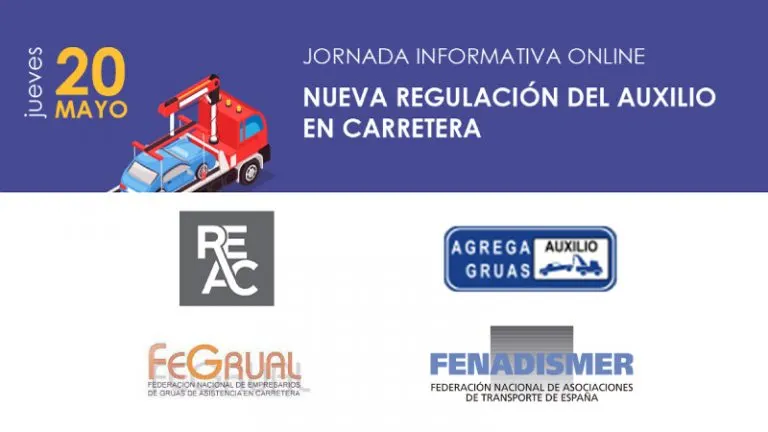
The Royal Decree on Roadside Assistance was the subject of an online training session promoted last week by REAC and other sector organisations.
"New Roadside Assistance Regulation" was the title of the online training session held last Thursday, 20 May, organised by REAC (Red de Empresas de Auxilio en Carretera) together with AGREGA-GRÚAS, Fegrual (National Federation of Roadside Assistance Tow-Truck Employers) and Fenadismer (National Federation of Transport Associations in Spain).

These regulations, set out in Royal Decree 159/2021 governing Roadside Assistance services, which we discussed here, are a long-awaited legislative development in the sector. For many years, professionals, companies and organisations have been calling on the Administration for a change to guarantee the safety of people working in roadside assistance.
The key date is 1 July, when the Royal Decree comes into force and we will finally see first-hand how it is gradually implemented until it becomes a reality. Regulating safety conditions to eliminate workplace accidents is the main aim of the legislation. Geolocation, the new signs (V-16 and V-27) and the training requirement (one of REAC's strengths) are three of the most significant new features.
Speakers
This development of the regulations entails a change in the conditions under which assistance services on public roads carry out their duties, with new rights and obligations. Speaking on behalf of REAC about the need for it were Manuel Fernández Luque and Juan Villodre Mangado, president and board member of REAC respectively. Speaking for Fegrual were Xavier Martí Amigó and Marc Manent Gascá, likewise president and board member.
The panel of experts addressing the specific new features of the regulations was made up of José Carlos Rodríguez Álvarez (Technical Director of REAC), Juan José Gil Panizo (Secretary General of Fenadismer) and Emilio Domínguez del Valle (spokesperson for AGREGA-GRÚAS and legal adviser to REAC).
A total of 203 people registered for the free session, showing the interest this legislation is generating among tow-truck service workers. And no wonder, considering the conditions in which roadside assistance operators currently carry out their work. Since 2017, a total of 18 operators have lost their lives, according to the DGT. Working in roadside assistance is far too risky: it is hoped that this legislative change will reverse this trend radically.