
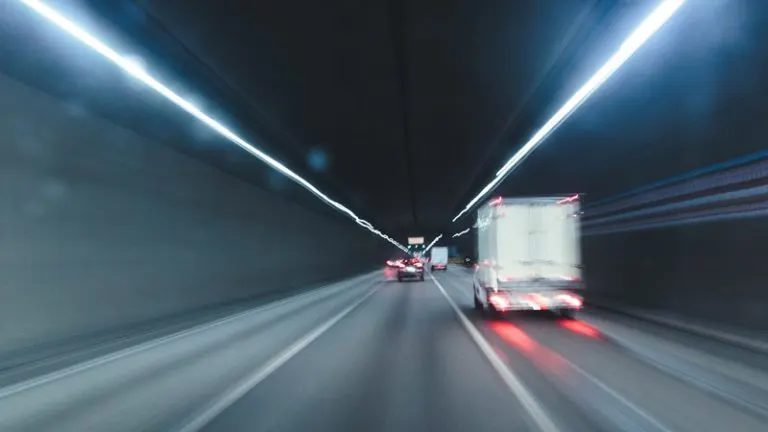
Before putting your foot down on a motorway, we should think about effects such as the tunnel effect, which can reduce our visibility and contribute to a dangerous situation. Almost without our realising.
When you experience the tunnel effect, what you see is the background: at the sides, nothing. The tunnel effect produced by excessive speed narrows the field of vision and prevents us from reacting quickly to an obstacle. Take an animal, for example (incidentally, we have already covered the subject of road accidents and animals here on the blog).
But let us get back to the tunnel effect. It is based on angles of vision (180º when we are stationary). What happens when we start moving? Our angle of vision gradually narrows as speed increases. So, at 65 km/h it would become 70º, while at 100 km/h it would drop to 42º. If we were mad enough to take the vehicle up to 150 km/h, the angle of vision would be barely 18º.
The Dirección General de Tráfico explains it very clearly in this video, aptly titled: The tunnel effect. The video was part of a series illustrating the “Mejor, más despacio” (“Better, slower”) campaign in January 2019. The campaign aimed to raise awareness of the reform of the General Traffic Regulations, which in December 2018 set the speed limit at 90 km/h on conventional roads.
As the DGT itself reported in 2015, the Colegio de Ópticos-Optometristas de Andalucía had studied how images of objects and people were projected onto the retina in a blurred way because of speed. Which in short reduced visibility. And, of course, increased the chances of having an accident.
How to avoid tunnel vision?
The collective report “Los accidentes de tráfico: una problemática juvenil” (“Road accidents: a youth problem”) (Fundación Francisco Ferrer, 1995) presented DGT data showing a liking for speed among most drivers, regardless of age: 90 % of drivers exceeded the speed limit on dual carriageways, then set at 100 km/h (until 1992, when it was brought into line with that of motorways), while 30 % were capable of taking the car up to 140 km/h with astonishing calm.
Today, the limit on a motorway or dual carriageway is 120 km/ for cars, motorcycles, motorhomes and pick-ups. However, living and driving fast is still a culture that shows no sign of abating and is a danger, not only to drivers but to the whole community.
The percentage of accidents involving high speed remains high, even though factors such as distraction are now sadly coming to the fore as well. The only way to avoid the tunnel effect is to follow road signs and abide by the traffic rules.