
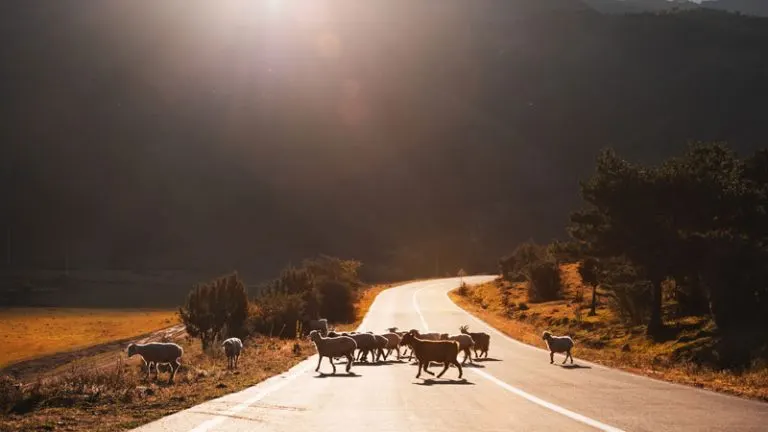
Where should animals driven in herds or flocks travel? And pets? There are general and local rules that must be complied with, relating to non-domestic animals and pets.

The passage of the transhumant flock through the capital -during the Transhumance Festival- gives us, every year, the lovely sight of the flock roaming freely through the Puerta del Sol. But in general, anything to do with animals on the move is not a very familiar subject for many people, unless they work with animals or live with pets at home. Perhaps for this reason, accidents involving animals, as well as being particularly serious -when animals are hit, for example-, are so disconcerting for drivers (we published an article on the subject in 2020).
Of course, within the group of animals, a draught or pack animal, or a saddled one, is not the same as loose livestock -in a herd or flock-, or a domestic animal. Can an animal be left unattended on a public road? The answer is no, and this also applies to dogs and pets, which must be kept on a lead, although it is municipal by-laws that set the rules in each place.
Both animal-drawn vehicles and animals in general are prohibited from travelling on dual carriageways and motorways. Nor may these vehicles be driven on roads where this is expressly prohibited.
Animals without a drovers’ road: travelling in herds
Non-domestic animals may only travel on public roads when there are no livestock routes, drovers’ roads or suitable tracks for them. In addition, they must be attended at all times by a person over 18 years of age. In the case of animals without a drovers’ road, they must travel at walking pace and on the right-hand hard shoulder; if they have to use the carriageway, they must always keep close to the right-hand edge, so that they never occupy more than the right-hand half.
When the public road has to be crossed, authorised and signposted crossings should be sought; in any case, the person guiding the herd, who is responsible for it, must do so with the necessary safety conditions.
When you spend most of your working time on the road, it is extremely useful to know these regulations, especially if you regularly travel through rural areas. Non-human animals have to share the roads with us.