
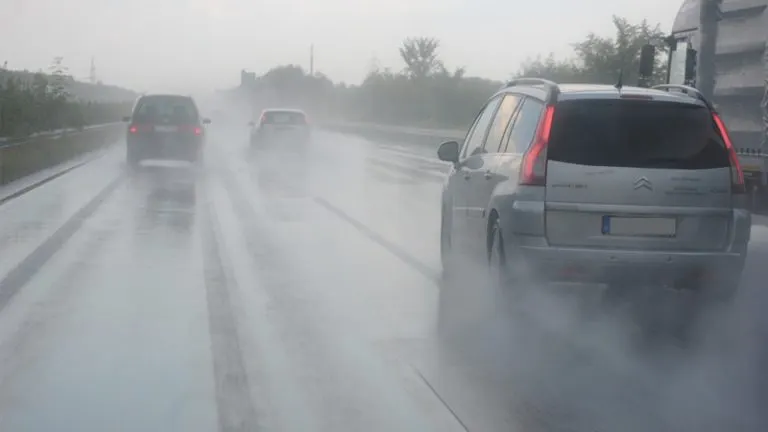
The dreaded aquaplaning can make us lose control of our vehicle. We need to know exactly when it happens. And above all, how to reverse the situation to avoid an accident.
María Moliner’s classic dictionary defines the anglicism aquaplaning as the “uncontrolled sliding of a vehicle due to a layer of water on the road surface that prevents the wheels from gripping”. Although some have adapted it into Spanish – calling the phenomenon hidroplaneo and acuaplaneo – we will use the best-known term which, today, is still aquaplaning.
Whenever we talk about how to drive safely in the rain, the word aquaplaning will inevitably come up. And this despite the fact that it is a situation that does not usually occur very often, as Bernabé Jiménez Padilla writes in the training manual “Técnicas básicas de mecánica de vehículos”. That does not stop it from being highly dangerous.
Aquaplaning, says Jiménez Padilla, “occurs when driving on a wet surface and the pressure of the water being channelled away through the tread pattern equals the external pressure”. The resulting skidding effect causes the vehicle to lose “all the grip needed to travel in a straight line, as well as when changing direction on bends”. The consequence is loss of traction. And of steering control.
Preventing aquaplaning
The most important thing is to avoid this effect before it happens. That is why the tread depth of the tyres must be correct, since these grooves allow the wheel to channel the water away properly. Tyre pressure matters too. But perhaps the key recommendation is to keep to an appropriate speed and to avoid sudden braking – as well as abrupt changes of direction – when driving on roads covered with a layer of water, snow or ice… however thin.
Reacting to aquaplaning

If the car plays a nasty trick on us, or we simply have not followed the recommendations above… a pool of water or a puddle can be extremely dangerous. If we find ourselves in an aquaplaning situation, we should follow this advice:
- When driving on a straight road, you need to hold the steering wheel firmly, press the clutch and gently release the accelerator. If, on the other hand, we are driving round a bend, we will do the same, except that we will have to turn the steering wheel in the direction of the bend, gently as well.
- Do not brake (even if it is your first reflex), for the simple reason that the tyres could lock and make us lose steering control of the vehicle. This could prove fatal.
- It is best to handle the episode as calmly as possible, keeping hold of the steering wheel and trying to regain control of the situation.