
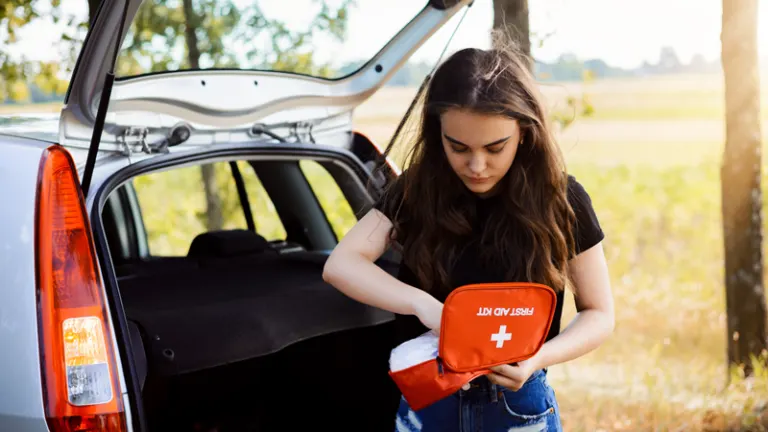
Germany, Austria and Greece are some of the EU countries that require an emergency kit to be carried on board a vehicle. This is not the case in Spain. However, for professional driving, it is advisable.
How many kilometres can we cover with our roadside assistance tow truck over our working days? Quite a few. Being well equipped with the stipulated tools, not only those required by regulations, can save us more than one mishap. We may cut or slightly injure ourselves while carrying out a manoeuvre, or suffer sudden pain (headaches, period pain, muscle pain…). We may be struck by a gastrointestinal upset. So it is worth asking whether an emergency first aid kit is compulsory. Is it or isn't it?
In principle, there is no specific European or national rule making it mandatory. What does exist is an international standard (DIN 13164), approved by, among other bodies, the Red Cross, which certifies first aid kits for vehicles. The name is an acronym of Deutsches Institut für Normung (German Institute for Standardisation).
In fact, countries such as Germany, Austria, Greece, the Czech Republic and Belgium make it compulsory, but Spain does not. Here it is simply a recommendation, and there is no penalty for not carrying a first aid kit.
And what should a travel first aid kit contain?
 Nowadays it is much more practical to buy one (they can be bought for 20 euros, although there are more expensive ones) rather than going to the chemist's to gather the essential products to fill your portable kit. DIN 13164 sets out the characteristics this kit must have:
- As for weight and dimensions, it must weigh 750 grams and measure 260x170x80 millimetres.
- It must be made of plastic, be impact-resistant and be kept in a dry place, away from direct sunlight; and of course it must be kept out of the reach of children.
- It must contain, among other items, eight plasters for small wounds, a large bandage with a sterile pad, three medium bandages with a sterile pad, a medium sterile cloth, two small sterile cloths, six sterile compresses, small scissors, disposable gloves, two triangular bandages, cleansing wipes…
- In any emergency, common medicines can come in very handy, as well as antiseptics and disinfectants to clean wounds properly.
- Another recommendation would be to check the condition of these medicines regularly and take them to the chemist's for recycling when they are out of date.
- And for top marks: if we can also include a written document with information about the nearest hospitals on our route.