
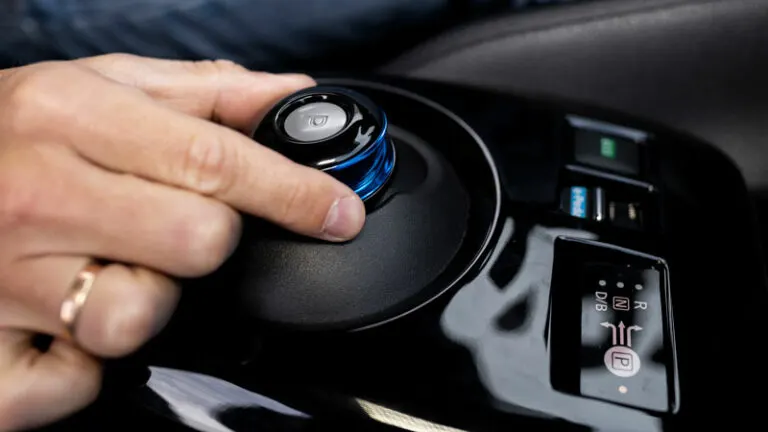
Travelling in an automatic car is easy, and not just for the co-driver or passenger! It is a matter of knowing certain rules in order to drive prudently and carefully. Here are some recommendations.
If we are one of those people who are afraid of driving an automatic car… this is definitely the article for us. Not only because an automatic car never stalls. It is a different type of driving, less stressful than changing gears manually. It is true that, with experience, handling the gear lever and clutch becomes almost "automatic", but it will never be like full automation. That said, there are certain concepts you need to master.
First of all, we need to know what each letter means. Generally, these cars have "P" for park, "R" for reverse, "N" for neutral, and "D" for drive. Although there are variants, such as "L" for "low", a mode used for going up or down hills or travelling on unpaved roads or tracks; or "N", a kind of manual mode but with restrictions, which sports cars usually have.
Things to bear in mind in an automatic
 What do we do with our left foot? Yes, the one that is usually so busy with the clutch… well, we do nothing, apart from leaving it on the footrest and getting used to using the right one, that's all. The right hand takes on a different role here, spending more time on the steering wheel, since there is no need to keep changing gear.
- What we do need to use properly are the positions. For example, applying the handbrake before leaving the car in "P". Or being in "D" when going down a hill, not in neutral ("N"). It is counterproductive – in short, bad practice… just as in manuals!
- You need to manoeuvre patiently and carefully, and not use the positions as a brake, wearing out the gearbox. For example, if we are reversing ("R"). Once the car has come to a stop, we will change to position "D". Not before.
- Another recommendation is that if we find ourselves in a traffic jam, with the car stationary for more than a minute, it is best to switch off the engine.
- Maintenance of an automatic car is the same as for a manual: it is key to a long life. Especially so as to avoid particularly costly repairs, such as replacing the gearbox. If we look after it, it will be our best motorised friend.