
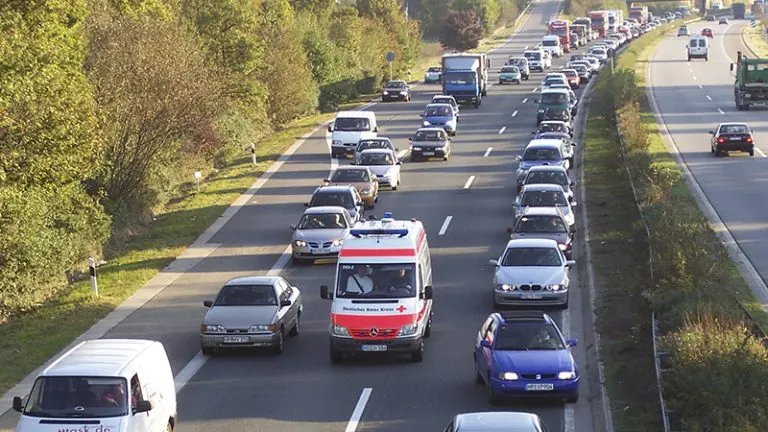
Although emergency lanes are not regulated, everyone has a moral obligation to make way for them. If we fail to do so, we face a fine of up to €200… and further penalties.
Ambulances, fire services, police, roadside assistance tow trucks… must reach the scene of an accident or emergency as quickly as possible. Hence the need for the emergency corridor effect. Not so much to prevent accidents—although it could also happen that they do prevent them—as to ensure that the emergency services reach the place where events are unfolding as soon as possible.
Saving lives and promoting safe driving in all circumstances comes first.
This is what the Dirección General de Tráfico (DGT) recommends, depending on the type of road we are on:
- On two-way roads, we must always move over to the right (in both directions).
- With two lanes in each direction, we must move over to the right if we are in the right-hand lane, and to the left if we are in the left-hand lane.
- With three lanes in each direction, we must move over towards the central reservation if we are in the left-hand lane; whether we are in the centre lane or the right-hand lane, we will have to move to the right
#BuenosDías
Do you know about the Emergency Corridor Effect?
If you hear or see an emergency vehicle needing to get through in a traffic jam or heavy traffic, don’t hesitate, do it. You could be saving a life. #BomberosElda#FelizMiércoles #DGTeros pic.twitter.com/w7ONIe4s60— Dir. Gral. Tráfico (@DGTes) May 8, 2019
The emergency corridor effect in the EU and Spain
Apart from Germany (since 1990), Austria and Hungary (since 2012), there is no regulation on this in Europe. What there is, in Spain’s case at least, is a recommendation to give way to emergency vehicles, either by moving over to the right or by stopping the vehicle.
If we fail to do so, as well as being uncivil and inconsiderate drivers, we face a fine for a serious offence. This failure to act is covered by the General Traffic Regulations (Article 69), and can lead to a €200 fine or the loss of points on our driving licence.
In Germany, for example, there are so-called emergency corridors (or rettungsgasse), which date back to the days of the German Democratic Republic (GDR), when the country was split in two. It was in East Germany that these corridors were regulated, specifically from 1971, according to this article by Feuvert, which analyses the German case in great detail.
With reunification, this rule was adopted into the Traffic Regulations. The idea was to open a gap, so to speak, between two lanes (when there were two lanes in each direction), or to leave the middle lane clear (if the road had three lanes).