
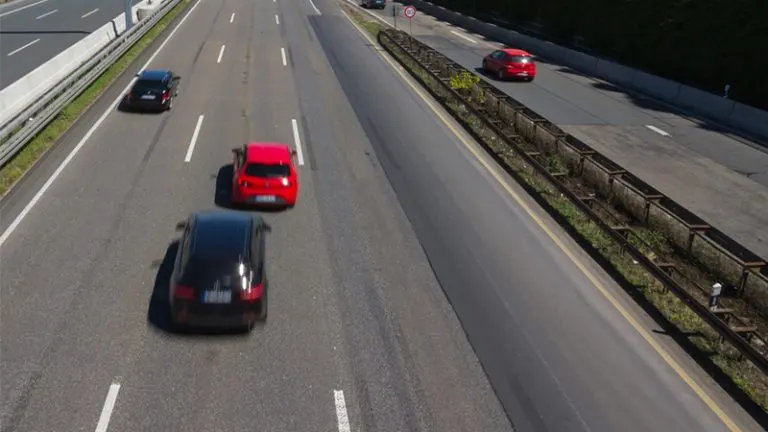
Braking comfortably to avoid dangerous rear-end collisions. Overtaking another vehicle properly. Keeping a safe distance is an obligation that every driver should take on from day one.
But is safe following distance a mathematical question? Of course not. It will depend on the weather conditions at the time (rain, ice or snow require a longer braking distance), the speed we are travelling at, the space between the vehicles on the road, and the condition of the road we are driving on. Drivers being overconfident about their cars may be the reason why vehicles can sometimes be seen driving far too close to one another; something incomprehensible, since the safe distance is a mantra taught from driving school itself, during training.
A safe distance must be kept from the vehicle in front of us, both when driving behind it and in order to overtake it alongside without endangering others. The Driver Regulations are clear: when carrying out a manoeuvre we must not "force other drivers to change their course or speed". And the figures for deaths and serious injuries in 2016 caused by rear-end and multiple collisions are dramatic: 145 and 1,000, respectively.
As for lateral distances, when overtaking we should leave at least one and a half metres between us and the vehicle we are overtaking. In the case of bicycles or motorbikes, extreme caution must be taken, given the greater vulnerability of cyclists and motorcyclists.
Two seconds
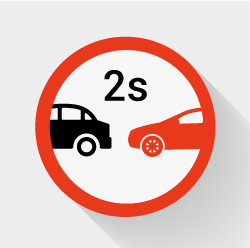
The Dirección General de Tráfico (DGT) offers approximate guidance on the "times" that the right distance should cover, although this is not always the same either. Here we have the "two-second rule", which is counted by saying "1101, 1102…". Fog and rain, as well as poor road surface conditions, may lead us to extend this to three seconds or even more. Bear in mind that in just two seconds we can travel 28 metres if we are doing 50 km/h. That distance would increase to 50 metres (if we are driving at 90 km/h) and to 66 metres (if we reach 120 km/h).
In tunnels, for example, we should keep a gap of four seconds or 100 metres, which should be increased if we are driving a heavy vehicle of more than 3,500 kilograms (in this case, the distance from the vehicle in front would rise to 150 metres or six seconds).