
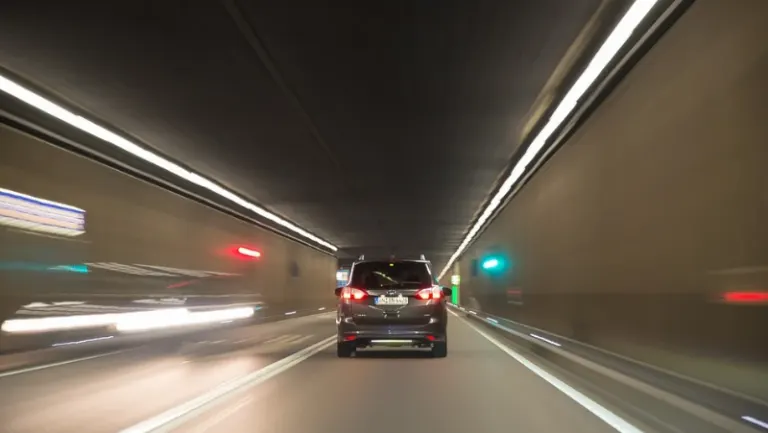
If on the road you can never be too careful, in a tunnel caution must be multiplied. In an emergency, assistance becomes much more complicated. Any kind of accident or incident in a tunnel must be avoided.
The road tunnel is an important piece of infrastructure that came about to get around water and terrain obstacles in general: from rivers to hills and mountains. The British managed to cross the Thames by road thanks to the Blackwall Tunnel, 1,361 metres long and built in 1897, as Ana Tapia Gómez recounts in “Topografía subterránea” (2005). The author, however, describes the Holland Tunnel (New York) as the first tunnel for motor vehicles in the strict sense; it crossed the Hudson River and was opened to traffic in 1927. It is listed as one of the US Historic Places.
Tapia Gómez explains that, as the car and road transport evolved, more tunnels were built. As with railway tunnels, roads needed more direct routes, eliminating steep gradients.
Driving through a tunnel: tips
When we enter a tunnel, we need to take its characteristics into account: its length, the number of lanes, whether it is two-way, and so on. A short two-lane tunnel is not the same as mega-infrastructures such as the M-30 tunnels (Madrid): the largest urban tunnel network in Europe. The heavier the traffic, the more caution is needed.
Road safety in this type of infrastructure is shaped by the environmental conditions we experience when entering it. Visibility drops sharply, to begin with. And any recklessness can prove costly. Nor is it enough simply to switch on your lights or take off your sunglasses as you enter.
Here are some basic recommendations:
- Make sure the fuel tank is full, and that the engine temperature is correct as well. Switch on dipped headlights and tune the radio to the traffic information frequency, which is usually indicated at the tunnel entrance.
- The safety distance is sacred, even more so when we enter a tunnel. Did you know that damp increases braking distance?
- The prudent thing is always to avoid any kind of overtaking. All the more so if it is a two-way tunnel.
- If we come across an incident, we must keep a prudent safety distance, while switching on our lights and turning on the air recirculation system. A fire, for example, can be fatal; follow the instructions of the monitoring staff and get to safety as soon as possible.
- It is important to note the SOS areas, as well as where the fire extinguisher posts are. If the tunnel is of a certain size, it will have an emergency area, and that is where we should head in the event of a breakdown, for example; in a smaller tunnel, pull the vehicle over to the right as far as possible.
- We must drive with caution, without exceeding the speed limits, signalling any manoeuvre with the indicators.