
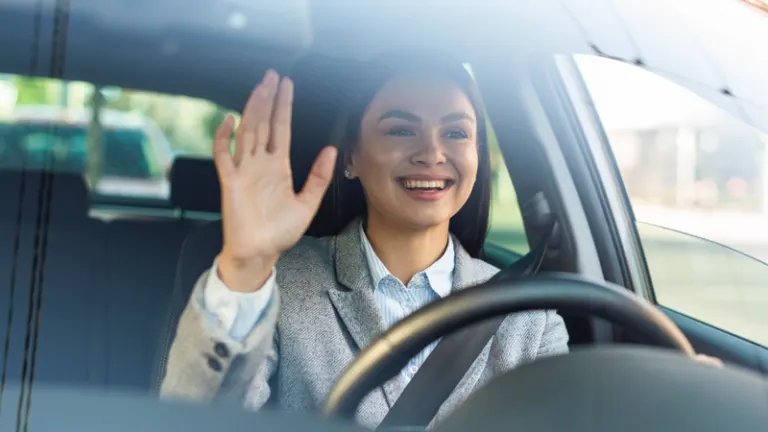
There is no better way to humanise ourselves and promote good manners behind the wheel than to communicate with our hands. We will also be making the road a friendlier, safer place.
It happens that sometimes, all shut away in our vehicles – less so on a motorcycle, where we are a little more exposed – we behave as if we were the machine itself rather than people. Human beings capable of using non-verbal communication behind the wheel as a set of good practices which, as well as showing road courtesy, are fundamental to road safety itself. Our own and that of others.
The American anthropologist Edward T. Hall (1914-2009), a scholar of body language – and the creator of the discipline of proxemics – identified a series of distances that increase the less familiar we are with one another. These ranged from intimate distance (15-45 centimetres) to personal (46-120 centimetres), social (360 centimetres) and public distance (beyond 360 centimetres).
What about drivers' signals? These take place at a public distance, where, however, we do not interact directly with other individuals, drivers like ourselves. They are very necessary, because of the information they provide and the courtesy they represent. These would be the most common examples:
 Raising your hand facing forward is a thank-you, and is used in various situations, usually as a courtesy when another driver has let us in when merging, for example. But it also serves as an apology when we have made a mistake.
- Opening and closing the hand, in a pinching motion, is a gesture intended to remind another driver that they must use their indicator. Indicators are essential for manoeuvres such as changing lanes or turning.
- Moving the hand up and down is a warning when you notice another driver is travelling at an inappropriate speed. It is essentially an invitation to ease off the accelerator.
- Showing the index finger and thumb as if measuring something short means, to the person we are gesturing to, that they are not keeping a safe distance.
- Another gesture would be raising your hand to your face, as if talking on the phone, to warn another driver that they are using it (improperly, if they are driving).
- Extending the left hand downwards announces a left turn. If we bend the same hand at a 90-degree angle, we mean that the turn is to the right.
- Extending the hand backwards announces that we are going to reverse.
- Extending the left arm and moving it up and down with short movements is the gesture used to announce that we are going to stop or park our vehicle.