
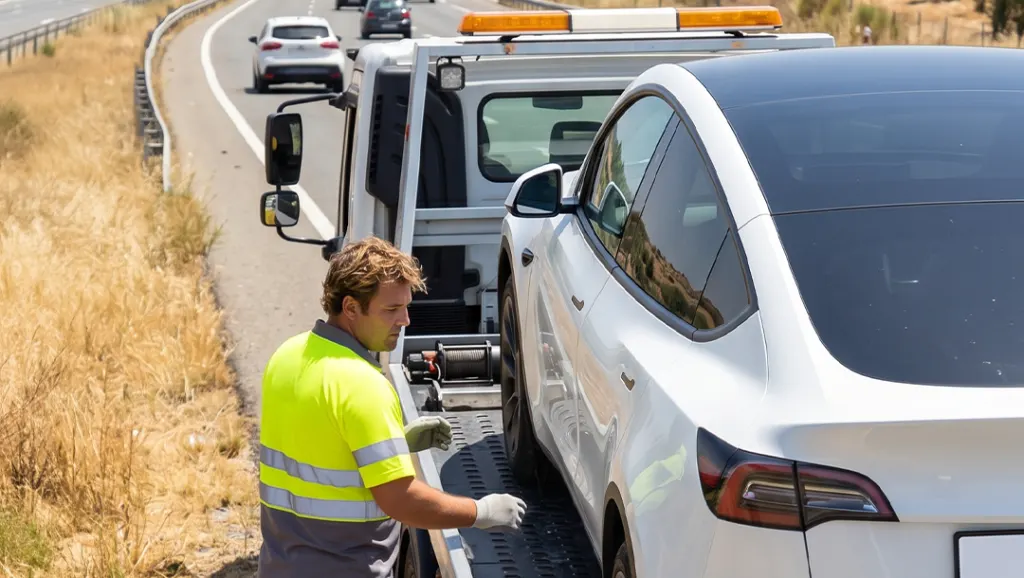
Assisting a broken-down electric vehicle, especially under the extreme thermal stress conditions of summer, demands specialist technical knowledge that is far removed from the protocol used for traditional combustion engines. At the REAC Network we analyse the two critical pillars that every professional and user should know about.
The danger of forced rotation: Thermal and regenerative risk
One of the most serious and costly mistakes that can be made when rescuing an electric car is allowing the drive wheels to turn freely on the tarmac while it is being towed.
When the drive wheels move with the motor switched off, the vehicle's retention system and regenerative braking are forcibly activated. This unintended action generates electrical energy that is sent directly to the inverters and the main traction battery. As the car is inactive and the liquid cooling systems are not running at full capacity, destructive voltage spikes or critical overheating can occur which, in the worst case, can lead to a spontaneous thermal fire. The use of full platforms or towing dollies is therefore mandatory.
Structural integrity: The map of the vehicle's underside
Unlike combustion cars, where the chassis offers relatively accessible standard anchor points, electric vehicles house their most sensitive and expensive component —the battery cell pack— across the entire floor of the passenger compartment.
A tow-truck operator must be trained to identify with millimetre precision the specific towing points set by each manufacturer. Using an incorrect hitching point or applying an inappropriately angled pulling force can deform the car's floor, puncturing or compressing the battery structure, which would completely void the manufacturer's warranty and create a severe chemical and short-circuit risk.
Continuous technical training is the only viable response to the challenges of new sustainable mobility. At REAC we are committed to the highest level of training for our member bases to ensure that technological innovation always goes hand in hand with operational safety on the road.
Would you like to know more?
If you would like to know how this integration benefits your company or how to become part of our network, visit our Private Area or get in touch with us at: