
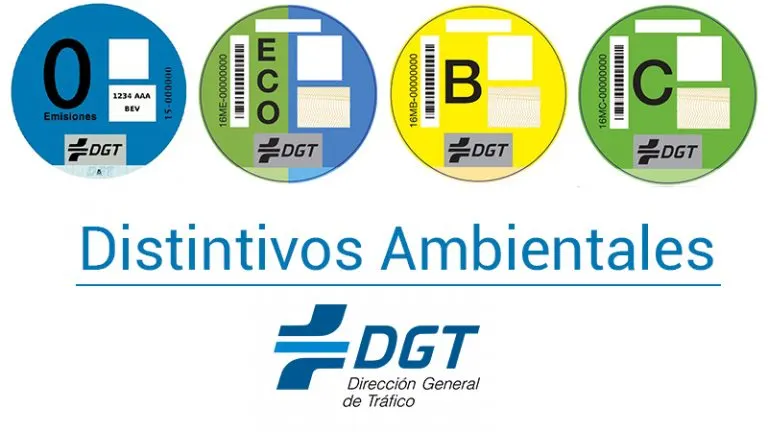
The Plan Aire (2013-2016) proposed classifying vehicles according to the carbon dioxide they emitted. These voluntary labels bring a set of distinctions that are worth clarifying.
“How to find out which sticker my car has”. It is the existential question for many drivers, and it can be answered by entering the vehicle's registration number on the DGT website. But why this labelling of vehicles now? It distinguishes zero-emission car models from older and therefore more polluting vehicles. The National Air Quality Plan (Plan Aire) stated, less than five years ago, that road traffic was the main source of particle and nitrogen dioxide emissions, hence the proposal to categorise vehicles.
Regardless of traffic restrictions, whether we are starting to take an interest in eco cars or in the environmental C sticker, we should know what each of these four categories means. The labels must be placed in the lower right-hand corner of the windscreen:
Zero Emissions environmental label

It is blue and applies to the following types of vehicle: battery electric vehicles (BEV), extended-range electric vehicles (REEV), plug-in hybrid electric vehicles (PHEV) with a range of 40 km, or fuel cell vehicles.
ECO environmental label

It is green and blue and applies to plug-in electric vehicles with a range of less than 40 km, non-plug-in hybrids (HEV), and vehicles powered by natural gas (CNG and LNG) or liquefied petroleum gas (LPG).
C environmental label

It is green and applies to cars and light vans registered from January 2006 (petrol) and from 2014 (diesel). It also applies to vehicles with more than eight seats and heavy vehicles registered since 2014 (petrol or diesel).
B environmental label

It is yellow and applies to cars and light vans registered from January 2000 (petrol) and from 2006 (diesel). It also applies to vehicles with more than eight seats and heavy vehicles registered from 2005 (petrol or diesel).
- There are also “unlabellable” vehicles, so to speak: those registered before 2000 (petrol) or before 2006 (diesel).
How do you get the labels? By asking at your nearest post office or through the Correos website. The sticker can also be obtained through the Spanish Confederation of Workshops (CETRAA) or from this DGT-authorised distributor, among others.
Is it compulsory to put these labels on every vehicle? For the moment, it is voluntary. However, given the legislation already passed on reducing emissions, they are useful, as they will favour the cars and vehicles that are most respectful of the environment.
> Images from the DGT