
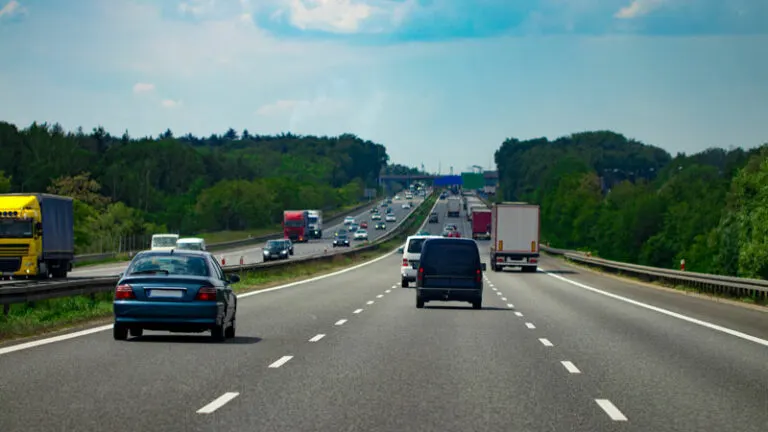
They cannot extend beyond a kilometre and a half. And you need to know how to use them, since they combine an acceleration and a deceleration lane. The DGT is explaining how they work.
Weaving lanes are – as the Directorate-General for Traffic (DGT) recently explained – acceleration and deceleration lanes. They are interurban lanes, common on dual carriageways and motorways, where the paths of vehicles joining and leaving the road cross; this happens when there is not enough space for a proper acceleration and deceleration lane. They can be recognised by their road marking: a thick broken line.
Below, we list the rules for driving on these lanes properly and safely. The DGT has reported the most recent accident figures for these lanes, from 2020: 57 accidents, 87 casualties (two fatalities, five seriously injured and 81 slightly injured). You need to apply a great deal of common sense (precisely what is so often lacking on the road!) to use them… especially when a vehicle wanting to join and another wanting to leave meet in the lane:

How do we join the dual carriageway?
- You must give way to vehicles already travelling on the main carriageway.
- Next, signal the manoeuvre, keeping a safe distance at all times.
- Then accelerate and complete the merge progressively.
- Vehicles vehicles already travelling on the dual carriageway should make it easier for others to join, whenever possible.
How do we continue along the weaving lane?
- You need to adapt your speed to the traffic in the lane, observing the signs and road markings and keeping a safe distance.
- Vehicles entering the weaving lane must give way to those already travelling in it (these have priority), signalling the manoeuvre, adapting their speed and keeping a safe gap.