
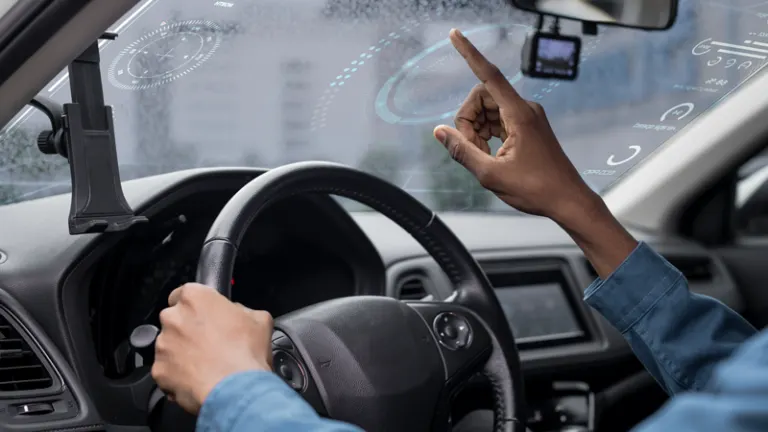
It was once a feature of high-end vehicles, although over the years it has become more common. It is, however, an expensive extra. A technology that was born, like so many, in the aeronautical industry.
In 2011, windscreen information systems were an extra for vehicles, mainly luxury ones. This very comprehensive Xataka article already claimed that, within a decade, so-called Head-Up Displays (known by the acronym HUD) would be much more widespread in cars. “Head up” is an English compound meaning “to be at the front of”; it made sense to give this name to an element that seemed a little like science fiction and which, in today's optional systems, usually costs more than 1,000 euros.
“Screen windscreens”, as this technology can also be called, involve projecting useful and important information for the driver onto the vehicle's glass. The sensation when looking at this projection is that the data seem to “float” in front of the windscreen itself, which is why we do not need to focus elsewhere. This floating screen was born in 1942 (as has happened with other technologies) in the military aeronautical industry.
Pilots could check certain relevant data by looking at the cockpit glass, but without being distracted. The invention would move into civil aviation and the automotive industry in the late 1980s. It did so thanks to Chevrolet, which had included it as a futuristic feature in 1965 in its Corvette Mako Shark II model. Oldsmobile began producing it in 1988, as did Nissan in a couple of models and General Motors, which would bring the HUD system to the Pontiac Grand Prix of the time in the late 1990s. It arrived in Europe thanks to BMW, in 2004.
Other features of the HUD
Speed and the speed limits of the area we are driving through, among other navigation data, are some of the information that can be displayed on the windscreen thanks to this system. The data have now diversified, so it is possible to see directions from the satnav, and it can also warn of pedestrians or animals near the carriageway at night. The most advanced use augmented reality.
Both height and brightness can be adjusted for the driver's comfort. There are fixed ones, but also helmet-mounted ones (HMDs, or Helmet Mounted Displays); in this case, the information is projected onto the helmet visor, or onto a lens, always at eye level, so that we do not divert our attention.