
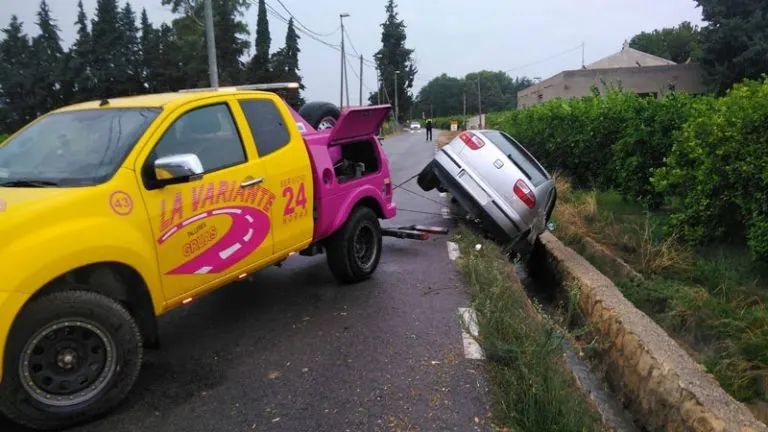
When an innovation helps to improve safety, we all win. That must have been what Diego Nicolás Gil, of Grúas La Variante, thought: the creator of the Crash Saver system.

Last October we reviewed the 3rd edition of Fireca, the International Rescue, Assistance and Emergencies Fair, held at the Seville Exhibition and Conference Centre (Fibes), of whose Organising Committee REAC is a member. One of the most moving moments of the event is, as always, the awards ceremony, which recognises contributions made to the roadside assistance sector, represented by the Roadside Assistance Companies Network (REAC).
In addition to the REAC member companies that obtained their AENOR certification, a number of professionals were also given awards thanks to their contribution to safety at work. This was the case of Diego Nicolás Gil, manager of Grúas La Variante.
Recognition of merit
Developing new devices to strengthen Road Safety for all road users is no easy task. But in the case of Diego Nicolás Gil, his track record and professionalism have been key in setting out to devise the Crash Saver system which, in the words of José Ángel Pérez Requena (international doctor in Law and Road Safety), “is gaining notable public prominence across all public administrations and institutions in the road safety sector”.
So much so that the manager of Grúas La Variante himself has been appointed a member of REAC’s National Road Safety Committee. And rightly so, considering this professional’s concern for safety on the road, an issue that, as we have seen recently with the #NIUNOMÁS campaign, needs definitive awareness-raising.
What does the system consist of?
According to its creator, the Crash Saver system is designed for use especially on dual carriageways and expressways. Installed in any vehicle, if that vehicle approaches a point where another vehicle has stopped because it needs assistance, it will emit a wave that, within 300-500 metres, will transmit a sound warning of the obstacle.
Diego Nicolás Gil has explained what this device would be like -here, in this video-; it aims to combat deaths on the road among professionals such as tow-truck operators, but also emergency personnel, the Guardia Civil Traffic Unit, infrastructure maintenance staff, etc.