
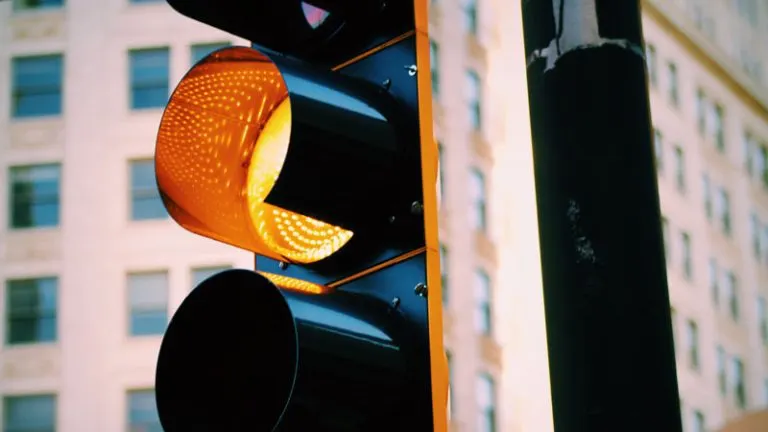
Controlling pedestrian crossings with traffic lights where the amber light flashes is being called into question. Although the intention is good, the ambiguity they create is a danger for vulnerable road users.
Their use is being questioned. At least at junctions in the cities where they began to be used some time ago as a way of easing congestion. The flashing amber light, which lets pedestrians cross while not stopping vehicle traffic, places all road users in an ambiguous situation. And of course, as tends to happen with anything that is not perceived as a precise order, it can lead to accidents, especially pedestrians being knocked down. The Dirección General de Tráfico (DGT) is clear about the difference between a steady amber light (which requires the vehicle to stop, according to the Highway Code, article 146) and a flashing amber light, which does allow you to keep driving.
But with the utmost caution.
Those municipalities that have introduced a flashing amber sequence as a measure to improve traffic flow (at pedestrian crossings controlled by traffic lights) had their reasons for implementing this measure, all perfectly logical. The problem is that, despite seeing the green pedestrian signal on the traffic light and having priority to cross, the possibility of being run over is still there. These arrangements become even more dangerous when a cycle lane also crosses the pedestrian crossing.
International organisations such as the European Transport Safety Council, as well as associations of road violence victims such as Stop Accidentes, ASPAYM (Association of people with spinal cord injuries and other physical disabilities) or P(A)T Prevención de Accidentes de Tráfico, among others, already expressed their concern about the amber light in 2022. The DGT is particularly attentive to pedestrians and other vulnerable users within mobility.
Pedestrians must pay the utmost attention
 One of the most dangerous situations arises when, before crossing, the lane nearest the pedestrian is occupied by a commercial vehicle, such as a lorry or bus. If this vehicle stops but the one in the adjacent lane does not, the person using the crossing risks being run over by the vehicle in the adjacent lane. On the other hand, the temptation not to stop at a flashing light, if we are driving a car, is equally there.
Common sense should warn us to be more careful behind the wheel: if a large vehicle does stop and is next to us, a pedestrian may be getting ready to cross, or may already be on the crossing with no way back… what could happen then? It is not hard to imagine.
That is why victims' associations such as the aforementioned P(A)T recommend, before crossing, looking in the direction the traffic is coming from and paying particular attention to the driver (seeing whether they are focused on the wheel or distracted by the radio, or much worse, talking on their mobile). Taking the trouble to look at the drivers in front of us can save our lives.