
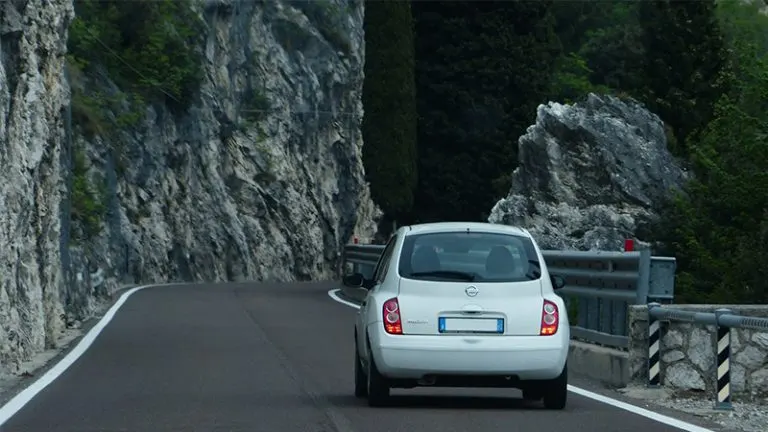
Mountain passes, which we climb to the top of or descend one after another as we drive, are a typical feature of the mountains. How should we drive downhill? And the other way round? A few practical tips never go amiss, do they?
Roads through mountainous areas – both inland and on the coast, overlooking cliffs and with sea views – make for a fascinating route, especially when travelled with plenty of free time and a desire to enjoy the scenery. They are also used by many people who, for work reasons, have to travel to more remote places (this applies to hauliers, as well as to other professional drivers or roadside assistance operators), and who find themselves having to drive on steep gradients and climb sharp inclines.
Narrow and winding, they would not necessarily be dangerous if we were all more responsible; hence the recommendation to take extreme care when using them. As well as driving a properly prepared vehicle – maintenance in general is key, as is the condition of the tyres – when we drive on these secondary roads we must bear the following in mind...
Going up
- It is essential to pay attention to road signs, both for speed and for warnings of bends and their direction (as well as their characteristics, which will determine the speed at which we can drive). We must take note of signs warning that the climb is dangerous, which show the gradient of the road as a percentage (for every 100 metres, we climb 10 metres).
- There is no point in accelerating too much, since in this context, if we put our foot down, we are more than likely to end up braking constantly.
- Attention must be at its highest at all times, especially if we intend to overtake safely, since these are areas where overtaking is practically forbidden because there is not enough visibility.
Going down
- Bends are just as important when descending a slope, above all given the possibility of meeting another vehicle coming the other way. A sharp bend must be taken by braking gently, changing down a gear and avoiding crossing into the opposite lane; in this respect, you cannot be too careful with large vehicles, since these may well take up part of your lane. Watch out!
- Chevron signs are very useful for anticipating how dangerous each bend is (a single sign means you need to reduce your speed by 15 to 30 km/h, for example).
- If the weather is bad, all the more reason not to speed.
- Let's be careful about braking too much on the way down (it could "throw us off" the bend), and avoid coasting in neutral (it is very dangerous, and it is not true that it saves fuel).