
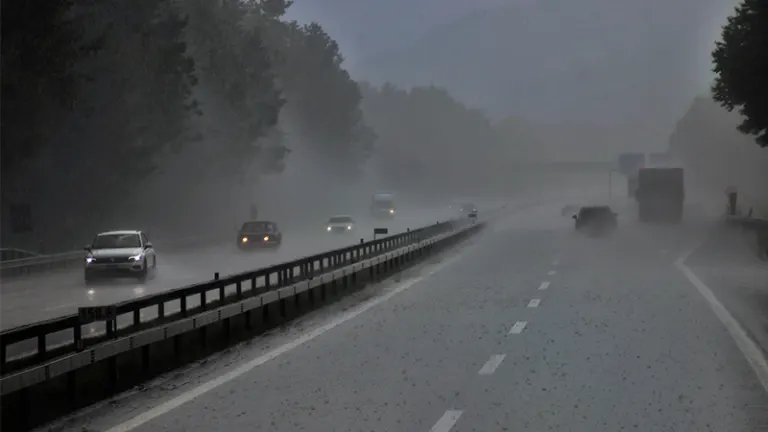
The "gota fría" (cold drop) phenomenon devastated part of the country last week, and once again showed that, when torrential rain is forecast, the best thing to do is stay at home.

Not taking any vehicle out is the most sensible option. But prudence is not always the best friend of human beings who, by underestimating a danger, can sometimes get into serious trouble. It is also true that other people are obliged to drive in the course of their duties. Just a few days ago the State Meteorological Agency (AEMET) warned of two low-pressure systems merging – one from the Mediterranean and another from the Atlantic – which could bring rainfall of 200 litres per square metre in just 12 hours.
Andalusia, Catalonia, Castilla-La Mancha and southern Extremadura were on alert, although the worst of it hit the Valencian Community, which endured a historic rainstorm, especially in the province of Castellón. Meanwhile, municipalities such as Arahal (Seville) and the Málaga towns of Sierra de Yeguas and Campillos were affected by flooding.
Vital recommendations
What should you do during a "gota fría"? If you do end up taking the car – or you work with a vehicle, as is the case with tow truck services or traveller assistance companies – Protección Civil urges everyone to drive slowly, take extreme care and, above all, avoid stopping in flooded areas. There is good reason for this. Did you know that a car can be swept away by the current if the water reaches half a metre, or that a flood can rise in a very short time? Currents, with their unbeatable force, are extremely treacherous.
For this reason, driving on main roads, motorways and dual carriageways will be safer than venturing onto secondary roads, tracks or places near rivers, torrents or streams; we should also keep away from coastal areas where the waves can become dangerous. A flash flood can be fatal, which is why you need to think very carefully about where to park the vehicle, if there is no choice but to take it… of course.
Once torrential rain has begun, we do not know whether an area will flood or not; but the danger is there. You should never drive or walk through a flooded stretch: turn around and find an alternative if necessary.

For safety, the best thing is to head for the highest ground.
If the situation is relatively safe, there is the option of staying inside the vehicle, with your seat belt on.
And what if the vehicle's engine cuts out? The first thing to do is switch on the hazard lights and move it to the side of the road, if possible. To seek immediate help by communicating with other drivers using Morse code, we will flash our full-beam headlights in the following sequence: three short flashes, three long and three short (which means SOS). When we are in trouble, someone might decipher the message and lend us a hand.