
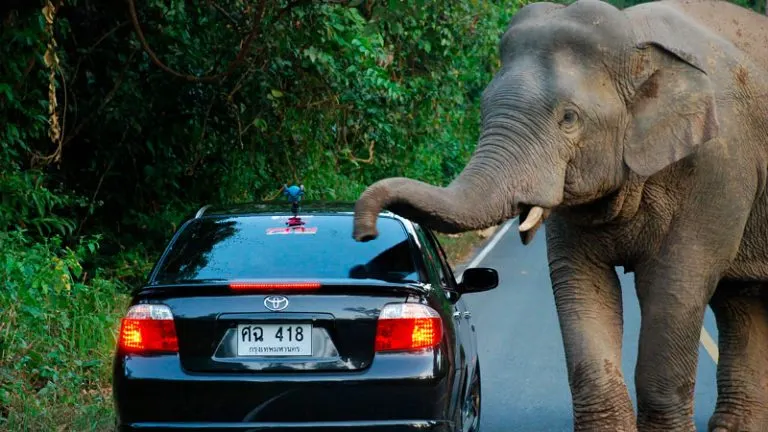
Restraint in a vehicle, of both passengers and objects, is extremely important. In an accident, any animate or inanimate object becomes a very dangerous projectile.

Are you one of those people who, despite it being compulsory, still play down the importance of the seat belt in the rear seats of the vehicle? Aren’t you deterred by the 200-euro fine or the loss of three points on your driving licence? That is because you don’t know what the elephant effect is. The Dirección General de Tráfico (DGT), always keen to educate people about safe driving, some time ago released a series of graphics—we show you one of them—that illustrate very clearly how any passenger or object can become the worst possible projectile if an accident occurs.
The concept of the elephant effect originated in France following a road safety campaign aimed at promoting seat belt use. The message was clear: “Don’t travel with an elephant in the back seat”. In the event of a collision or heavy impact, both the people travelling in the car and the objects we carry are subject to the physical law that says: if there is no restraint, the moving weight will be multiplied. It’s simple.
Sadly, it is very common for a large proportion of the victims on the roads each year not to have been wearing a seat belt (in 2018 they accounted for 23 % of people killed in accidents, according to the DGT). We are talking about 185 people. Far too many, considering how easy it is to fasten your seat belt.
The DGT also places the emphasis on short journeys, where we perhaps relax more about how we travel or what we leave loose in the vehicle. Bottles, shopping bags, books, mobile phones or tablets… may seem harmless to us. But their volume and weight could prove fatal in an accident.
The elephant effect in figures
Perhaps talking in figures will make it clearer. At a speed of just 60 km/h, a passenger weighing 75 kilograms would hit the front seat with a force similar to the weight of an elephant (4,200 kilograms). This would be, as the DGT puts it, “the effect of the effect”, in this case on the person driving (apart from the harm one can suffer oneself by travelling without a seat belt: the chances of being thrown from the vehicle increase).
The examples go beyond the elephant. At 50 km/h, we would be talking about 787 kilograms (the equivalent of a giraffe); and a laptop can be just as dangerous at the same speed (85 kilograms, in this case equivalent to a wild boar). As speed increases, each of these objects—even a full baby’s bottle—would be enormously harmful. So beware of the elephant effect.
Image source: Revista DGT