

Signage is adapting to times in which safe coexistence between vulnerable road users and commercial and heavy vehicles is becoming a priority.
Times are always changing. Road safety concerns are too. In this case, the Directorate-General for Traffic (DGT)’s concern for the vulnerable is behind the creation of a new sign aimed precisely at vulnerable road users (VRU), namely: pedestrians, motorcyclists, cyclists, users of Personal Mobility Vehicles (PMV), as well as people with disabilities or reduced mobility and orientation (PRM).
This voluntary sign contains a warning of the danger of “blind spots”. The Ministry of the Interior has launched it through the DGT, and has aimed it at coaches, light commercial vehicles, rigid lorries, tractor units and municipal waste collection vehicles.
Reasons for a new sign: road vulnerability
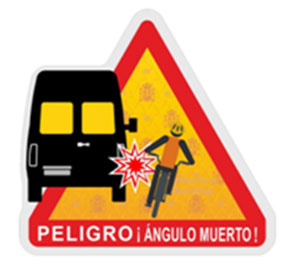
Cyclist deaths in cities reached the highest figure on record in 2019: 32. But in 2020 alone, 153 pedestrians, 134 motorcyclists, 21 cyclists and 7 PMV users lost their lives on urban roads. Moreover, too high a percentage of these were accidents involving commercial and heavy vehicles.
There are factors that could lead to an increase in this type of accident. In cities with increasingly diverse mobility, where home deliveries have increased -especially during the pandemic-, vulnerable road users need to acknowledge precisely their own vulnerability.
Furthermore, this signage has not been introduced only here. In this respect, Spain is following in the footsteps of France, London and certain parts of Germany. Another key factor in this concern lies in the existence of older vulnerable road users, whose numbers continue to rise due to the progressive ageing of the population in Europe.
A voluntary sign for transport and goods vehicles
Thus, goods vehicles of different categories (N1, N2, N3, municipal waste collection vehicles) and passenger vehicles with more than nine seats -including the driver- are the ones that may display this sign as a warning to vulnerable road users approaching their blind spots. No one will be obliged to display it, at least for now.
However, it seems that the responsible thing will be to do so. In Spain, in April this year, there were an estimated 7,700,000 cyclists and 1,133,000 PMV users on the roads. This, together with, as the DGT Instruction itself explains, “the boom in logistics activity, deliveries resulting from e-commerce and collective public transport” makes it essential to reduce risk situations as far as possible within this coexistence. So let us welcome this new sign.
Image source: DGT.