
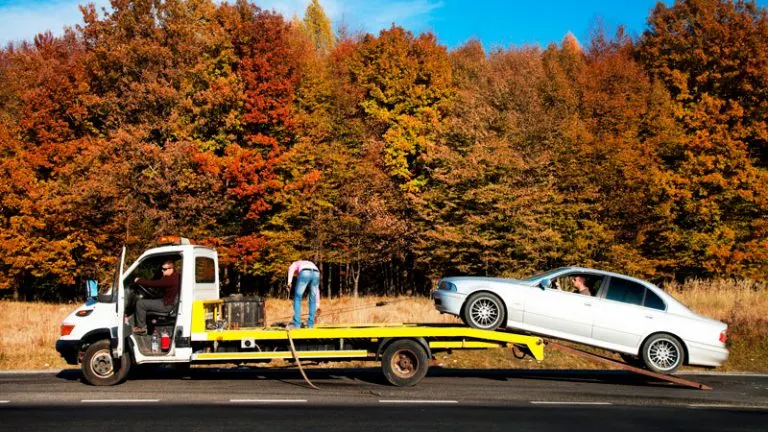
The situations a roadside assistance operator faces can be very tough. Yet it is possible to dream of this trade. Even of owning a tow truck.
Mark Oliver Everett -better known as Eels- recounts that he once dreamed of owning a tow truck. “The way I saw it, it was a great opportunity. I’d be my own boss, with plenty of time to think and sort out my ideas. I had some experience with roadside assistance from when I worked at the petrol station, and I’d liked it. I tried to persuade a friend to be my partner in the tow truck and split the shifts, but he never really warmed to the idea,” he writes in “Things the Grandchildren Should Know”, his successful autobiography, published in Spanish by Blackie Books in 2009.
Was the American musician idealising roadside assistance work a little? Possibly. But it is also true that this trade gets you hooked, just as tow trucks hook up vehicles every day on every road. Today we will talk about precisely that, about tow trucks and flatbeds: the most common tow trucks.
Both the equipment and tools and the vehicle fleet of a roadside assistance company are crucial to carrying out its work. Work that, as we explained in this article, deals with very different situations.
That is why we asked ourselves which are the most common vehicles in the fleets offering a professional tow-truck service:
1. Flatbed tow trucks (platform)
Popularly known as flatbed tow trucks, these are the ones we most often see on the roads. The vehicle is not subjected to pressure or dragging, but is transported safely and comfortably on a platform, usually made of steel, which tilts so the vehicle can be loaded. They are not suitable when a vehicle has been in an accident, if it is left in such a state that it cannot be pulled onto the platform.

2. Hook and chain tow trucks
The classics are not always the best. These are the traditional tow trucks, although their use has become quite restricted, mainly because of the use of chains.
3. Wheel-lift tow trucks
We see them mainly assisting in car parks and enclosed spaces with little room to manoeuvre, although also on the roads. They have a metal yoke that hooks onto the vehicle and a hydraulic or pneumatic lift that raises it, making transport simple. They are usually used for vehicles that have been in some kind of accident and cannot be moved, as mentioned above, with a flatbed tow truck.

4. Boom (hanger-type) tow trucks
This is another type of car-carrying tow truck used in the event of an accident, as it makes it possible to haul a vehicle that is badly damaged and cannot roll normally.