
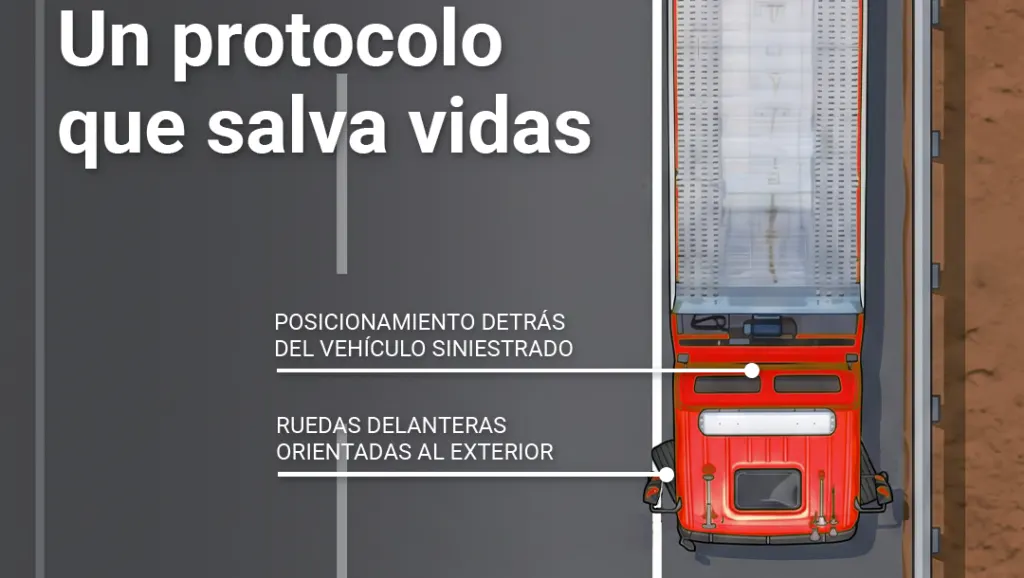
Below, we analyse the anatomy of this tactical procedure and why its strict application makes the difference between a safe job and a workplace tragedy.
1. Tactical positioning: The tow truck as a physical barrier
The first step on arriving at the scene of the incident is positioning the assistance vehicle. The tow truck must always be placed behind the broken-down or crashed car. In this way, the heavy vehicle acts as a protective screen. If another driver is distracted or loses control of their car, the impact will be absorbed by the structure of the tow truck, protecting the space in front where the operator and the occupants of the assisted vehicle are located.
2. Safety steering: Wheels towards the verge
Parking behind is not enough; the orientation of the tow truck's front tyres is a matter of life or death. The wheels must always be left turned towards the outside of the carriageway (towards the hard shoulder or verge), never straight or pointing towards the live lanes.
Why is this detail critical? If the tow truck suffers a major rear-end collision, the inertia of the impact will propel it forwards. With its wheels turned, the priority vehicle will naturally move towards the safe area of the road (the right-hand edge) instead of being pushed into the flow of traffic, preventing a multiple pile-up.
3. The exclusion zone and protected movement
Once the physical shield has been established, the protocol dictates that no one must step onto the tarmac under any circumstances. All movement of people, preparation of towing equipment and boarding of occupants must take place exclusively on the right-hand side of the road, the space protected by the mass of the tow truck itself and the broken-down car.
At the REAC Network we understand that the professionalisation of the sector depends on continuous training in these industrial safety standards. Commitment to zero risk on the road is our absolute priority.
Would you like to know more?
If you would like to know how this integration benefits your company or how to become part of our network, visit our Private Area or get in touch with us at: