
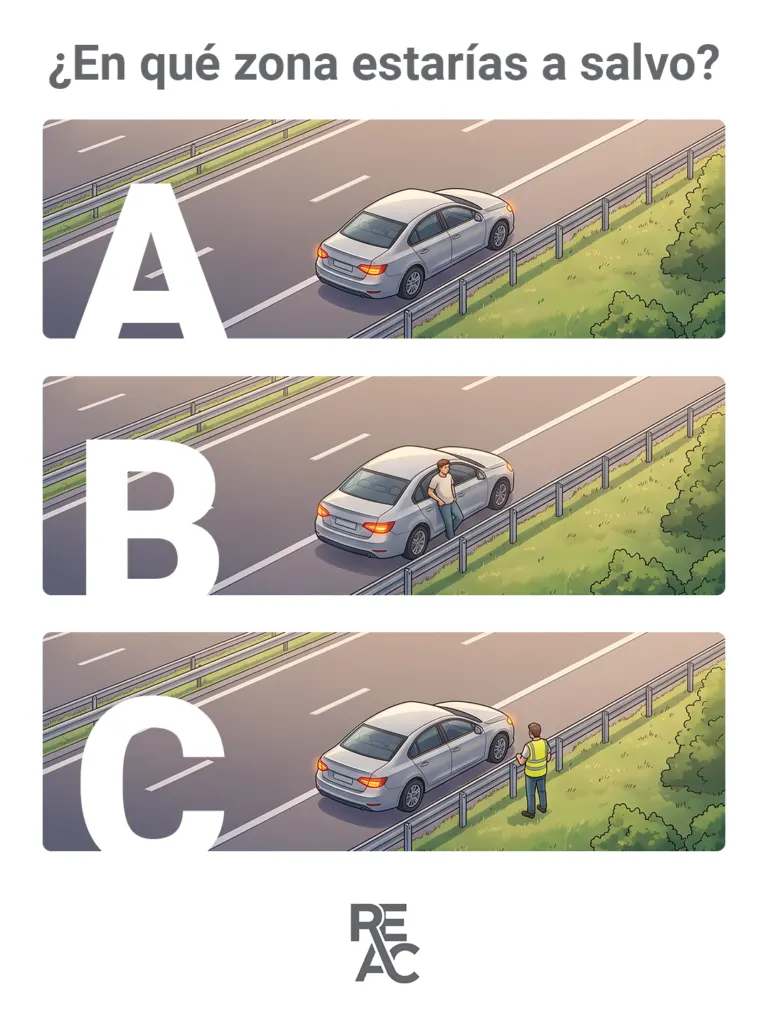
Survival guide for the hard shoulder: The technical protocol that 80% of drivers fail
Picture the scene: you are travelling in the middle of the holiday season, the thermometer shows an extreme temperature outside and, suddenly, your vehicle's engine gives up. You manage to manoeuvre and stop the car on the right-hand hard shoulder, next to a metal crash barrier. You have to wait for the REAC assistance tow truck to arrive. What do you do at that very moment?
The statistics from our bases reveal an alarming figure: 80% of drivers fail this road safety test in summer. Most make mistakes that put their physical safety at immediate risk out of sheer convenience or unawareness of the real danger of the hard shoulder.
The three waiting options: Which would you choose?
- Option A (Incorrect): Staying inside the passenger compartment with the air conditioning on to protect yourself from the extreme heat.
- Option B (Incorrect): Waiting standing on the hard shoulder itself, close to the side of the vehicle, watching out for the tow truck.
- Option C (Correct): Putting on your reflective vest, getting out through the passenger door and positioning yourself firmly behind the crash barrier, away from the carriageway.
| Passenger Location | Risk Level | Technical Reason |
| Inside the vehicle (Option A) | 🔴 Very High | A car stopped on the hard shoulder acts as a magnet for secondary rear-end collisions. It is not a safe refuge. |
| On the hard shoulder (Option B) | 🔴 Critical | You are directly exposed to high-speed traffic. Any outside distraction is dangerous. |
| Behind the crash barrier (Option C) | 🟢 Safe | The metal barrier absorbs impacts and places you outside the road's running lanes. |
New technologies, new risks on the road infrastructure
When the vehicle suffers a mishap, the self-protection protocol must be immediate. Get out safely on the side away from the traffic (passenger door) and seek the protection of the outer infrastructure (verges or embankments behind the safety barriers). Once you are in a safe place, request the service from your insurer. Our call handler will remind you of this procedure immediately to ensure your protection.
If you also drive a hybrid or fully electric vehicle, managing the breakdown changes. We invite you to read our complementary guide carefully: The challenges of new mobility: Critical protocols for assisting electric vehicles in summer. In it we explain in detail how initial handling, thermal insulation and system shutdown require additional steps to secure the battery cells against high summer temperatures before the tow truck begins towing.
Would you like to know more?
If you would like to know how this integration benefits your company or how to become part of our network, visit our Private Area or get in touch with us at: