
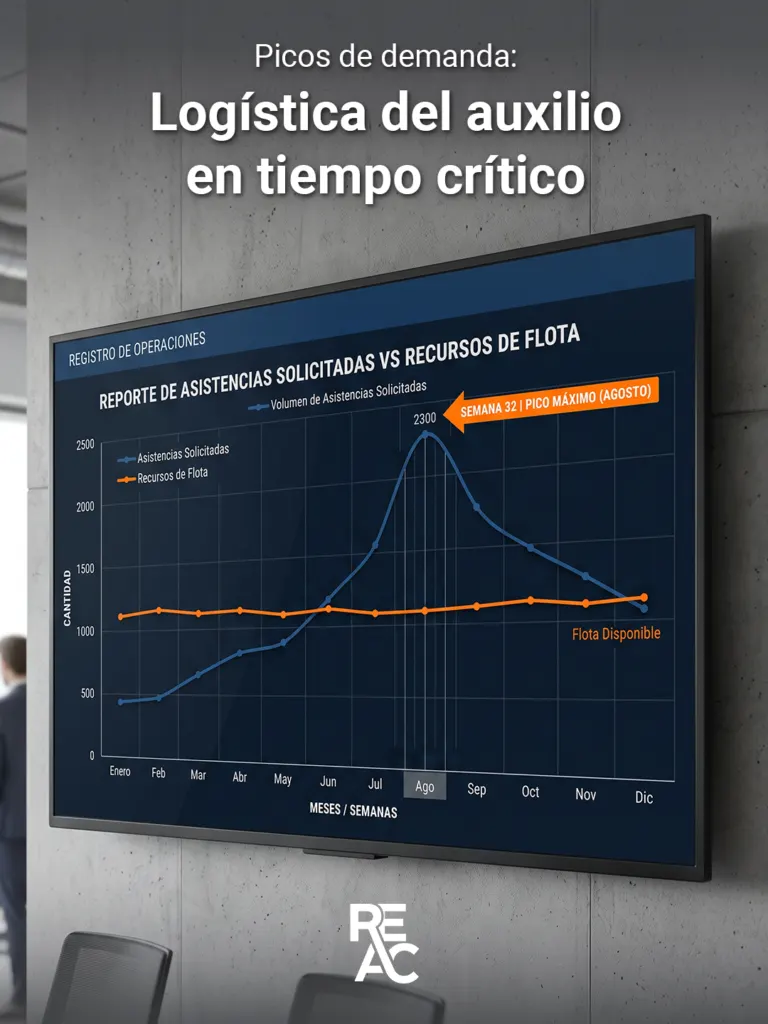
The central weeks of summer represent the greatest logistical and operational challenge of the year for the Red de Empresas de Auxilio en Carretera (REAC). During this period, coinciding with mass holiday travel, calls requesting roadside assistance soar to as much as 40% above the annual average.
For a tow truck to reach your position on a gridlocked dual carriageway in severe temperatures, our member SMEs must activate a high-precision organisational deployment that remains invisible to the ordinary user.
The three pillars of the technical fleet assistance strategy
Preparing to absorb these extreme demand peaks is not improvised; it is planned months in advance through three fundamental strategic lines:
- Data-based predictive geolocation: By analysing the historical accident records of previous campaigns, assistance bases strategically pre-position their fleets at the road junctions and black spots with the highest likelihood of mechanical incidents. This drastically cuts arrival times when the alert comes in.
- 100% structural fleet maintenance: During the preceding months, the workshops at our bases meticulously inspect every hydraulic and mechanical component of our flatbed tow trucks. The aim is to ensure that no technical equipment fails when market pressure is at its highest.
- Real-time traffic and route management: Operations teams reorganise job assignments second by second. If a dual carriageway becomes gridlocked, operators look for alternative secondary routes to get around tailbacks stretching for kilometres, always prioritising rescues in the highest-risk areas of the hard shoulder.
The impact of new powertrains on roadside assistance logistics
This complex roadside assistance logistics operation not only has to deal with the volume of calls and traffic, but also with the technological diversification of the vehicle fleet. The arrival of alternative powertrains requires our operators to apply specific knowledge on the road.
If you would like to learn more about how innovation is redefining assistance work, we invite you to read our specialist article: The challenges of new mobility: Critical protocols for assisting electric vehicles in summer. In this technical piece we break down how REAC personnel protect traction battery systems, eliminate the risks of reverse current from friction (regenerative braking) and use specialised equipment so that transport is flawless in situations of extreme heat.
How to act correctly when you come across roadside assistance
The next time you spot emergency lights in operation on the hard shoulder, show real respect for the professionals who put their lives on the line by following this basic protocol:
- Don't brake to look or take out your phone: Keep a constant speed and your attention fixed ahead. The road is not a live show.
- Signal and move over: If traffic conditions allow, move into the left-hand lane to leave a wide lateral safety space from the tow truck and the operators.
- Keep traffic flowing: Remember that clearing the area as soon as possible helps the road return to normal and protects the lives of those working on the ground.
Would you like to know more?
If you would like to know how this integration benefits your company or how to become part of our network, visit our Private Area or get in touch with us at: